
The Foundational Role and Metallurgical Demands of the Pipe Tee
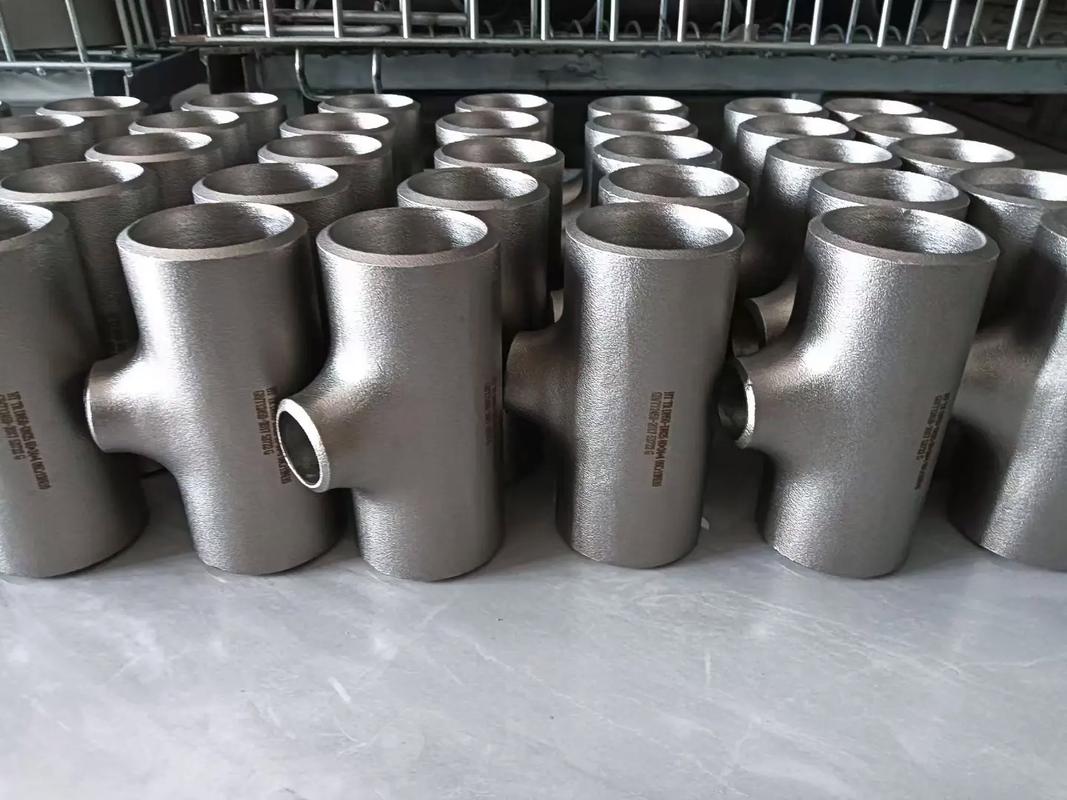
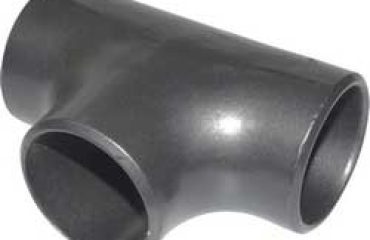
The pipe tee, a fundamental component in any fluid transport system, serves a critical function: providing a $90$-degree branch in a pipeline to allow for diversion, mixing, or equal distribution of the flow. While seemingly simple in geometry, its manufacturing requires significant plastic deformation—the forming of the branch connection—which introduces complex stress states and microstructural changes in the material. This inherent demand for formability, coupled with the need for the finished fitting to withstand the same, and often higher, internal pressures and external loads as the straight pipe to which it will be welded, dictates stringent metallurgical and manufacturing controls. The material choice for a tee is never arbitrary; it must perfectly match the pipe material to ensure seamless integration in terms of weldability, corrosion resistance, and thermal expansion compatibility.
The governing standard for many of the fittings listed, particularly the carbon and alloy steels, is ASTM A234/A234M, which specifies “Piping Fittings of Wrought Carbon Steel and Alloy Steel for Moderate and High Temperature Service.” This specification dictates the chemical composition, required heat treatments, and mechanical property testing necessary for the fitting to be certified for pressure applications. The stainless steel grades, while often manufactured using similar forming techniques, fall under related but distinct material specifications (e.g., A403 for wrought austenitic stainless steel fittings), but their final fitness-for-purpose is defined by the same core principles: preservation of the desirable microstructure and assurance of mechanical integrity after forming. The manufacturing process for a seamless tee typically involves a hydraulic bulging method or a hot-extrusion process, both of which require the material to be highly ductile at the forming temperature and necessitate a post-forming heat treatment to relieve residual stresses and restore the optimal microstructure, a step that is fundamentally mandatory for certification.
Carbon Steel Workhorses: A234 Grades WPB and WPC
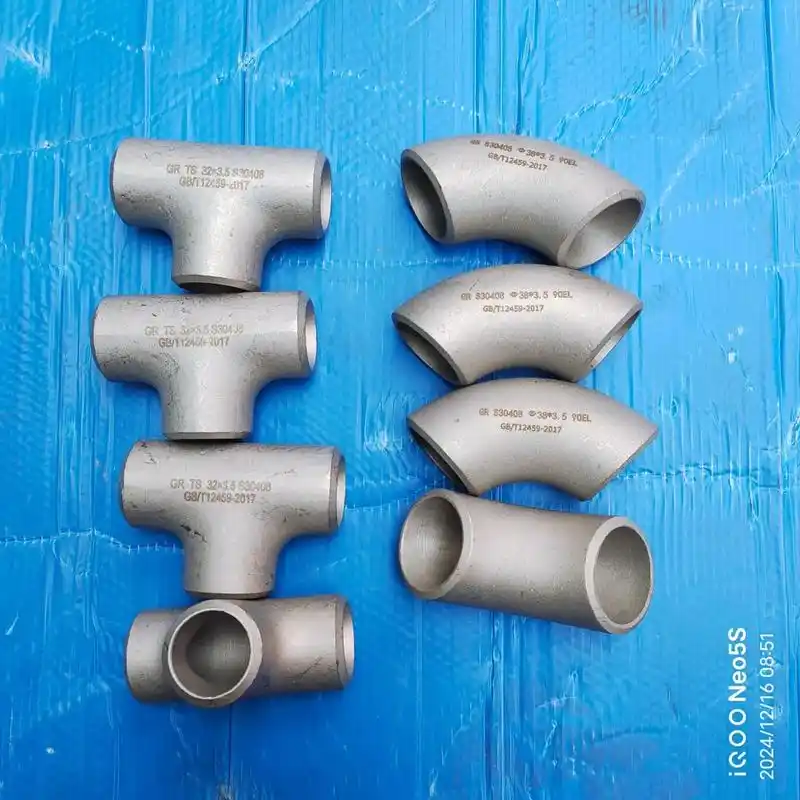
The grades WPB and WPC are the ubiquitous, general-purpose fittings in the moderate temperature and pressure piping industry. They represent fundamental carbon steels, with WPB being the standard grade and WPC offering slightly higher strength due to a marginally higher maximum carbon content and a tighter control on other alloying elements. Their metallurgical foundation is simplicity: an iron-carbon matrix with controlled amounts of manganese, silicon, and residuals. Strength is derived primarily from the pearlite content within the ferrite matrix, which is a function of the carbon level.
The technical constraints governing these grades are centered on weldability and notch toughness. Since these tees will be field-welded to carbon steel pipe, controlling the $\text{Carbon Equivalent Value}$ ($\text{CEV}$) is critical, though less stringent than in high-strength pipe. The low cost and readily available ductility of WPB/WPC make them ideal for ambient and moderate-temperature service, such as water, air, and non-corrosive hydrocarbons. However, their use is strictly limited by temperature (due to scaling and loss of strength) and by the presence of aggressive media (due to their inherent lack of corrosion resistance). A crucial requirement for both grades, especially after the plastic deformation of the tee formation, is the mandated normalization or stress-relieving heat treatment, which is performed to reduce the residual stresses accumulated during forming and to ensure a uniform, fine-grained ferritic-pearlitic microstructure that guarantees the required minimum yield and tensile strength.
Table I: Chemical Composition Requirements (ASTM A234 WPB and WPC – Wrought Fittings)
The compositional control focuses on ensuring good weldability and minimum strength. Values shown are maximum percentages unless a range is specified.
| Element | WPB Max (%) | WPC Max (%) |
| Carbon ($\text{C}$) | $0.30$ | $0.35$ |
| Manganese ($\text{Mn}$) | $0.29 – 1.06$ | $0.29 – 1.06$ |
| Phosphorus ($\text{P}$) | $0.035$ | $0.035$ |
| Sulfur ($\text{S}$) | $0.035$ | $0.035$ |
| Silicon ($\text{Si}$) | $0.10 – 0.35$ | $0.10 – 0.35$ |
| Chromium ($\text{Cr}$) | $0.40$ | $0.40$ |
| Molybdenum ($\text{Mo}$) | $0.15$ | $0.15$ |
| Nickel ($\text{Ni}$) | $0.40$ | $0.40$ |
| Copper ($\text{Cu}$) | $0.35$ | $0.35$ |
| Vanadium ($\text{V}$) | $0.08$ | $0.08$ |
The Creep-Resistant Alloys: WP91 and 15CrMoV
The jump from WPB/WPC to WP91 and 15CrMoV represents a transition from general-purpose service to highly specialized, critical high-temperature and high-pressure service, primarily within the power generation industry (superheaters, reheaters, main steam lines). These are low-alloy, creep-resistant steels, designed to maintain structural integrity and resist time-dependent deformation (creep) at temperatures well above $500^\circ\text{C}$.
WP91: The P91 Revolution
ASTM A234 Grade WP91 is the wrought fitting equivalent of $\text{P91}$ pipe, a modified $\text{9Cr}-1\text{Mo}$ ferritic steel. Its metallurgical architecture is a sophisticated balance designed to maximize high-temperature strength and oxidation resistance. The $9\%$ $\text{Cr}$ provides excellent resistance to steam-side oxidation, while the $1\%$ $\text{Mo}$ enhances high-temperature strength. Crucially, it is micro-alloyed with Niobium ($\text{Nb}$) and Vanadium ($\text{V}$), and tightly controlled with Nitrogen ($\text{N}$). This combination facilitates the formation of a fine dispersion of extremely stable secondary precipitates (e.g., $\text{V}$-rich $\text{MX}$ carbonitrides and $\text{Nb}$-rich $\text{M}_{23}\text{C}_6$ carbides) during the mandatory heat treatment. These precipitates are the backbone of the alloy’s creep resistance, effectively pinning grain boundaries and dislocations, preventing their movement even under sustained high stress and temperature.
The manufacturing and welding of WP91 are highly sensitive. Unlike carbon steel, WP91’s final properties are entirely dependent on a precise, two-stage heat treatment: Normalizing (to ensure a fully martensitic structure) followed by Tempering (to precipitate the strengthening phases and restore required toughness). Any deviation from the precise time and temperature windows during welding (requiring stringent preheating and Post Weld Heat Treatment – $\text{PWHT}$) or during manufacture will result in an inferior, potentially failure-prone component. This sensitivity necessitates the highest level of quality control, often including hardness testing and $\text{PWHT}$ monitoring to ensure the integrity of the $\text{MX}$ precipitates is maintained.
15CrMoV: A Classic Creep Alloy
The designation 15CrMoV often refers to a classic Chinese standard material ($\text{GB 5310}$) or similar European equivalents, representing a lower-alloy alternative to WP91, typically containing around $15\%$ $\text{Cr}$, small additions of $\text{Mo}$, and often $\text{V}$. This steel is designed for creep service, but generally in less extreme temperature and pressure regimes than $\text{P91}$. Its creep resistance relies on a ferritic-bainitic structure, strengthened by carbide precipitation, but lacking the high $\text{Cr}$ oxidation resistance and the ultra-stable $\text{MX}$ precipitates of $\text{P91}$. While more forgiving to weld than $\text{P91}$, it still requires careful $\text{PWHT}$ to ensure carbide stability and stress relief, reflecting the universal metallurgical challenge of all creep-resistant alloys.
Table I-B: Chemical Composition Requirements (WP91 and 15CrMoV – Wrought Fittings)
Note: 15CrMoV composition is based on typical industry specifications for the equivalent $\text{1.25Cr}-0.5\text{Mo}$ creep alloy, as the exact $\text{A234}$ equivalent may vary.
| Element | WP91 Max (%) | 15CrMoV Max (%) |
| Carbon ($\text{C}$) | $0.08 – 0.12$ | $0.12 – 0.20$ |
| Manganese ($\text{Mn}$) | $0.30 – 0.60$ | $0.40 – 0.70$ |
| Phosphorus ($\text{P}$) | $0.020$ | $0.035$ |
| Sulfur ($\text{S}$) | $0.010$ | $0.035$ |
| Silicon ($\text{Si}$) | $0.20 – 0.50$ | $0.15 – 0.35$ |
| Chromium ($\text{Cr}$) | $8.0 – 9.5$ | $0.10 – 0.30$ |
| Molybdenum ($\text{Mo}$) | $0.85 – 1.05$ | $0.40 – 0.60$ |
| Vanadium ($\text{V}$) | $0.18 – 0.25$ | $0.10 – 0.30$ |
| Niobium ($\text{Nb}$) | $0.06 – 0.10$ | – |
| Nickel ($\text{Ni}$) | $0.40$ | – |
| Aluminium ($\text{Al}$) | – | $0.040$ |
| Nitrogen ($\text{N}$) | $0.030 – 0.070$ | – |
The Stainless Steel Portfolio: SS304H, SS31603, and SS321H
The final set of materials represents the move into the austenitic stainless steel family, primarily chosen for their exceptional corrosion resistance and good high-temperature performance (though not for creep in the same way as $\text{WP91}$). These materials form a face-centered cubic ($\text{FCC}$) microstructure stabilized by nickel, which provides excellent ductility, toughness, and non-magnetic properties. Their primary specification for fittings is ASTM A403.
SS304H and SS321H: High-Temperature Oxidation and Sensitization Control
SS304H is the high-carbon variant of the standard $\text{304}$ alloy. The deliberately increased carbon content ($0.04\%$ to $0.10\%$) is included to enhance the material’s strength at elevated temperatures, particularly for service above $525^\circ\text{C}$ where creep may become a concern. However, this high carbon content makes it highly susceptible to sensitization—the precipitation of $\text{Cr}$-carbides ($\text{Cr}_{23}\text{C}_6$) at grain boundaries when exposed to temperatures between $425^\circ\text{C}$ and $815^\circ\text{C}$—which depletes the surrounding matrix of $\text{Cr}$, making it vulnerable to intergranular corrosion in service.
To counteract this, the SS321H grade employs a technique known as stabilization. It is alloyed with Titanium ($\text{Ti}$), a powerful carbide former that has a much higher affinity for carbon than chromium. By adding $\text{Ti}$ (in an amount five times the carbon content), the carbon preferentially forms stable Titanium Carbides ($\text{TiC}$) within the grain interior, thereby preventing the $\text{Cr}$-carbides from precipitating at the grain boundaries. This allows $\text{SS321H}$ tees to be safely used in the critical sensitization range (e.g., furnace components, exhaust systems) without the risk of subsequent corrosion attack. Like $\text{304H}$, the $\text{321H}$ designation implies a controlled, higher carbon content to ensure improved high-temperature strength.
SS31603 (316L): Superior Pitting and Crevice Resistance
SS31603 is the low-carbon version of the $\text{316}$ family, commonly referred to as 316L. The distinguishing feature is the addition of Molybdenum ($\text{Mo}$), typically $2.0\%$ to $3.0\%$. This $\text{Mo}$ is crucial for enhancing the Pitting Resistance Equivalent Number ($\text{PREN}$), providing significantly superior resistance to localized corrosion (pitting and crevice attack) in chloride-containing environments (e.g., seawater, certain chemical processes) compared to the $\text{304}$ family.
The “$\text{L}$” (low carbon, max $0.03\%$) designation makes $\text{316L}$ inherently resistant to sensitization during welding or fabrication, as there is insufficient carbon available to form damaging grain boundary $\text{Cr}$-carbides. This means that, unlike $\text{304}$ or $\text{321}$, $\text{316L}$ generally does not require a post-weld solution annealing to restore corrosion resistance, a major benefit in field fabrication. However, its low carbon content sacrifices some high-temperature strength, making it generally unsuitable for service above $425^\circ\text{C}$ where the $\text{H}$ grades would be selected for better creep performance.
Table I-C: Chemical Composition Requirements (Austenitic Stainless Steel Fittings)
The following values are based on ASTM A403/A403M requirements, representing the core chemistry of the wrought grades.
| Element | SS304H (Max %) | SS31603 (Max %) | SS321H (Max %) |
| Carbon ($\text{C}$) | $0.04 – 0.10$ | $0.030$ | $0.04 – 0.10$ |
| Manganese ($\text{Mn}$) | $2.00$ | $2.00$ | $2.00$ |
| Phosphorus ($\text{P}$) | $0.045$ | $0.045$ | $0.045$ |
| Sulfur ($\text{S}$) | $0.030$ | $0.030$ | $0.030$ |
| Silicon ($\text{Si}$) | $1.00$ | $1.00$ | $1.00$ |
| Chromium ($\text{Cr}$) | $18.0 – 20.0$ | $16.0 – 18.0$ | $17.0 – 19.0$ |
| Nickel ($\text{Ni}$) | $8.0 – 10.5$ | $10.0 – 14.0$ | $9.0 – 12.0$ |
| Molybdenum ($\text{Mo}$) | – | $2.00 – 3.00$ | – |
| Titanium ($\text{Ti}$) | – | – | $5 \times \text{C min}, 0.70 \text{ max}$ |
The Mandate of Heat Treatment: Restoring Integrity
For all these wrought fittings, the mandatory heat treatment following the forming process is not merely a formality; it is the critical step that defines the material’s fitness-for-service, eliminating the damage caused by forming and restoring the optimal, equilibrium microstructure.
Table II: Heat Treatment Requirements (WPB, WP91, and Stainless Steel Fittings)
The required heat treatments are fundamentally different due to the distinct metallurgical structures of the carbon, creep, and stainless steels.
| Grade | Heat Treatment Type | Temperature Range | Technical Purpose |
| WPB / WPC | Normalized or Stress Relieved | $1100-1600^\circ\text{F}$ ($595-870^\circ\text{C}$) | Eliminate forming stresses; refine/restore Ferritic-Pearlitic structure. |
| WP91 | Normalized and Tempered | Normalizing: $1900^\circ\text{F}$ ($\sim 1040^\circ\text{C}$); Tempering: $1350-1470^\circ\text{F}$ ($730-800^\circ\text{C}$) | Achieve fully tempered martensite structure; precipitate $\text{MX}$ phases for creep strength. |
| 15CrMoV | Normalized or Quenched and Tempered | Typically $900-1000^\circ\text{C}$ and $680-750^\circ\text{C}$ | Restore Bainitic/Ferritic structure; ensure stable carbides for creep resistance. |
| SS304H | Solution Annealed | $1900^\circ\text{F}$ ($\sim 1040^\circ\text{C}$) minimum, followed by rapid cooling. | Dissolve $\text{Cr}$-carbides and restore full corrosion resistance; relieve stress. |
| SS31603 | Solution Annealed | $1900^\circ\text{F}$ ($\sim 1040^\circ\text{C}$) minimum, followed by rapid cooling. | Restore maximum corrosion resistance and low-carbon stability; relieve stress. |
| SS321H | Solution Annealed & Stabilized | $1920^\circ\text{F}$ ($\sim 1050^\circ\text{C}$) minimum, followed by rapid cooling. | Dissolve all phases (including $\text{TiC}$); sometimes a lower-temp stabilization is added. |
The differences underscore the fundamental requirements of each material class:
-
Carbon Steels: Primarily stress relief and grain refinement.
-
Creep Steels (WP91): Highly specific temperatures are required to generate the complex, ordered precipitates that provide creep strength. The $\text{P91}$ normalizing and tempering temperatures are critical and are carefully chosen to optimize the $\text{MX}$ phase stability.
-
Austenitic Stainless Steels: The high-temperature solution annealing followed by rapid quenching is mandatory to dissolve any precipitated $\text{Cr}$-carbides (in $\text{304H}$) or $\text{Sigma}$ phase, thereby restoring the material’s full, uniform corrosion resistance. For the $\text{H}$ grades, this final heat treatment must also ensure the high-carbon strength is achieved.
Mechanical Integrity: The Guarantee of Performance
The final mechanical properties measured after the required heat treatment ensure that the tee can withstand the design loads without yielding prematurely. The relationship between yield strength and tensile strength is a measure of the material’s efficiency and ductility, while elongation confirms sufficient toughness and reserve plasticity to avoid catastrophic brittle failure.
Table III: Tensile Requirements (WPB, WP91, and Stainless Steel Fittings)
The following minimum tensile property requirements are dictated by ASTM A234 (for WPB/WP91) and ASTM A403 (for Stainless Steels).
| Grade | Yield Strength (0.2% Offset) Min, ksi (MPa) | Tensile Strength Min, ksi (MPa) | Elongation in 2 in or 50 mm, Min, % |
| WPB / WPC | $35$ ($240$) | $60$ ($415$) | $22$ |
| WP91 | $60$ ($415$) | $85$ ($585$) | $20$ |
| 15CrMoV | $45$ ($310$) | $70$ ($485$) | $20$ |
| SS304H | $30$ ($205$) | $75$ ($515$) | $30$ |
| SS31603 | $25$ ($170$) | $70$ ($485$) | $30$ |
| SS321H | $30$ ($205$) | $75$ ($515$) | $30$ |
The data highlights the stark differences in design philosophy:
-
WPB/WPC: Provides a balanced, moderate strength.
-
WP91: Offers significantly enhanced strength (nearly double the yield of WPB) at high temperatures, which is a testament to the success of its microstructural engineering. The yield-to-tensile ratio is high, reflecting the heavily strengthened, tempered martensitic structure.
-
Austenitic Steels: Exhibit a lower guaranteed minimum yield strength compared to the carbon/alloy steels, particularly $\text{316L}$, reflecting their primary design for corrosion resistance and toughness, not purely for static strength. However, their excellent work-hardening capacity often means their actual yield strength after forming is substantially higher than the minimum specified. $\text{304H}$ and $\text{321H}$ show slightly better minimum strength than $\text{316L}$ due to their higher carbon content. All stainless grades show high ductility, exceeding $30\%$ elongation, ensuring their exceptional toughness.
The final step for the tee is its integration into the piping system via welding, which presents a unique set of challenges tailored to each material’s metallurgical profile.
-
Carbon Steels (WPB/WPC): These are the most forgiving. Standard welding procedures, preheating only for thick sections or low ambient temperatures, and no mandatory $\text{PWHT}$ for thin sections. The main concern is ensuring proper root pass fusion, especially in the complex geometry of the tee.
-
Creep Steels (WP91 and 15CrMoV): These require highly specialized welding procedures due to their air-hardening tendencies.
-
WP91: Must be welded using strict preheat (typically $200^\circ\text{C}$ minimum) and carefully controlled interpass temperature to prevent the formation of untempered martensite, which is brittle and prone to cracking. A mandatory $\text{PWHT}$ (at $730^\circ\text{C}$ to $800^\circ\text{C}$) is required immediately after welding to temper the martensite and create the $\text{MX}$ precipitates. Failure to execute a proper $\text{PWHT}$ can result in a soft $\text{HAZ}$ (Type IV cracking susceptibility) or a brittle $\text{HAZ}$, severely compromising the long-term creep performance.
-
15CrMoV: Requires similar controls, though the preheat and $\text{PWHT}$ temperatures are typically lower and slightly less sensitive than WP91 due to the lower alloying content.
-
-
Austenitic Stainless Steels: These require unique handling to preserve corrosion resistance and control residual stresses.
-
SS304H: Welding is problematic because the weld heat cycle will sensitize the $\text{HAZ}$. Unless the final assembly can be solution annealed (which is impractical for a large plant), it should be avoided in corrosive service.
-
SS31603 (316L): The preferred welding choice for corrosive service. The low carbon content eliminates the need for $\text{PWHT}$ to restore corrosion resistance, making field fabrication simple. The main concern is controlling heat input to avoid hot cracking (due to low melting point compounds like sulfur or phosphorus) and limiting distortion due to the higher coefficient of thermal expansion compared to carbon steel.
-
SS321H: The presence of $\text{Ti}$ requires specialized welding filler metal to ensure stabilization is maintained in the weld zone. The $\text{Ti}$ also makes the weld metal sluggish and more challenging to handle than standard $\text{304L}$ or $\text{316L}$.
-
The diverse product line of stainless steel tees, spanning from the robust carbon steels to the high-performance alloy and austenitic stainless grades, embodies the complex and mission-critical nature of pressure piping components. The selection of the correct tee material is a fundamental engineering decision dictated by the most demanding service conditions:
-
WPB/WPC: The economic solution for moderate pressure and temperature, non-corrosive environments.
-
WP91/15CrMoV: The mandatory solution for high-temperature, creep-dominated environments in power generation, where absolute microstructural control (via normalizing and tempering) is the single most important factor for long-term safety.
-
SS31603: The default choice for corrosive service involving chlorides, offering excellent pitting resistance and easy field weldability due to its low carbon content.
-
SS304H/SS321H: Specialized grades for high-temperature service where oxidation resistance and strength are required, with $\text{321H}$ offering the critical titanium stabilization to avoid catastrophic sensitization in corrosive-high temperature regimes.
Each tee, regardless of its material, has been engineered through precise chemical limits, subjected to massive plastic deformation, and finally restored to its optimal state by a meticulously controlled heat treatment. The integrity of the fluid transport system relies entirely on the manufacturer’s ability to certify that every single tee meets the chemical, mechanical, and microstructural requirements laid out in its respective ASTM specification, ensuring it performs flawlessly under its specific operational envelope, from the static strength of a carbon steel tee to the long-term creep stability of a $\text{WP91}$ fitting at $600^\circ\text{C}$. The tees are silent witnesses to the flow of civilization’s most critical resources, and their flawless function is a constant testament to the science of materials engineering.
You must be logged in to post a comment.