
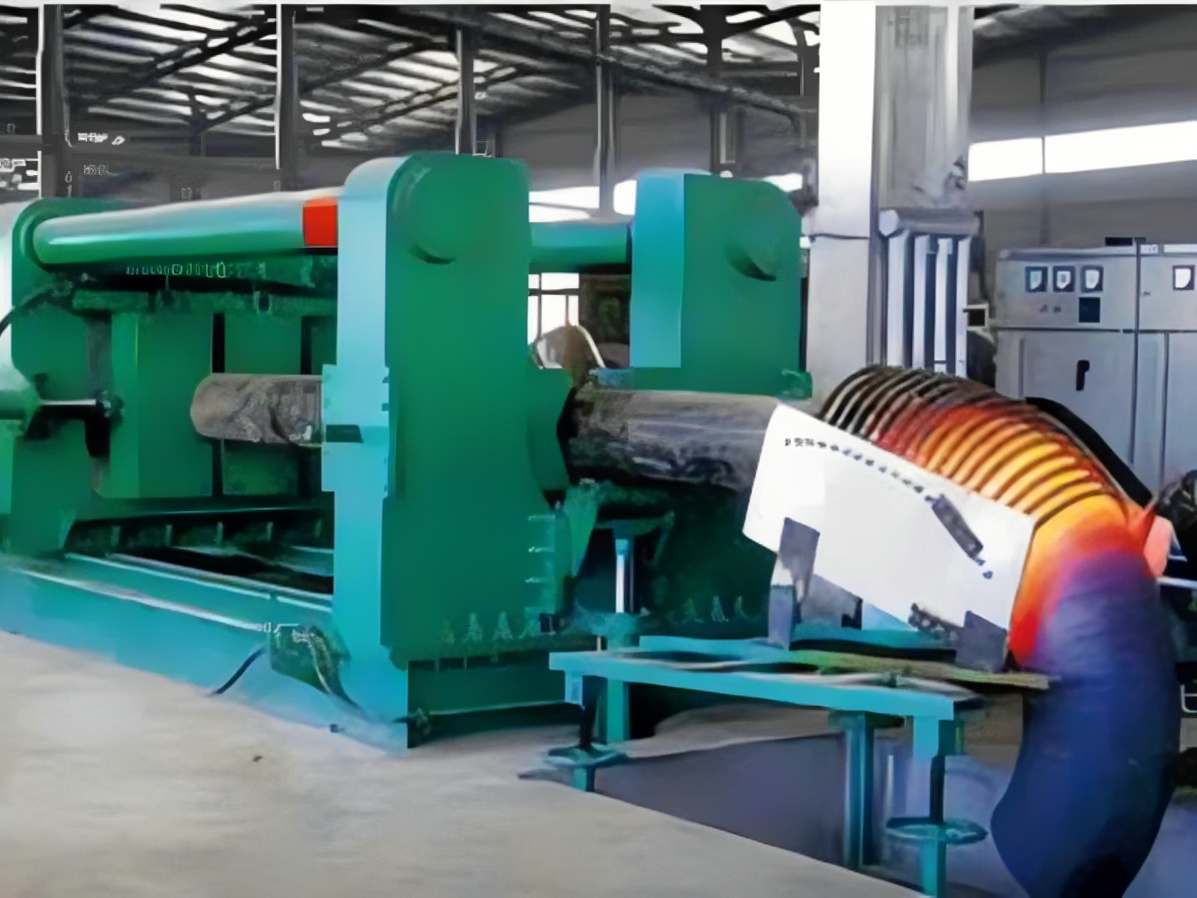
In the complex landscape of heavy industrial piping—where high-pressure steam, volatile hydrocarbons, and supercritical fluids are transported—the “elbow” is the most vulnerable and critical component. Among all manufacturing methods, the Hot-Push Mandrel Forming Process stands as the definitive standard for producing seamless elbows with uniform wall thickness and high structural integrity. However, as we push towards larger diameters and thinner walls, the process moves beyond simple mechanical bending and into the realm of non-linear plastic deformation, intricate thermal gradients, and complex friction interfaces.
The Inner Monologue of the Forming Mandrel: A Study in Plastic Flow
When I visualize the hot-push process, I see a dynamic struggle between the raw pipe segment and the horn-shaped mandrel. It is not merely a mechanical shove; it is a thermal-mechanical symphony. As the induction coil heats the carbon steel or alloy pipe to its austenitic state (typically between 850°C and 1050°C), the metal loses its yield strength and becomes a viscous, plastic medium.
The core challenge—the one that keeps engineers awake—is the Thinning of the Outer Arch (Extrados) and the Thickening of the Inner Arch (Intrados). In a standard bend, the outer wall stretches and thins. But in the mandrel process, we exploit the expansion of the pipe diameter over the horn’s profile. If the mandrel’s curvature and expansion rate are mathematically synchronized, the material from the inner arch is “pushed” toward the outer arch, effectively compensating for the stretching. This is the “optimization” we seek: a zero-sum game of material redistribution.
Process Parameters and Material Dynamics
To optimize the design, we must define the boundary conditions that govern the deformation zone. The following parameters represent the baseline for high-grade structural elbow production (e.g., ASTM A234 WPB or P22 alloys).
Table 1: Critical Process Parameters for Hot-Push Elbow Forming
| Parameter | Symbol | Unit | Value Range (Optimized) | Impact on Quality |
| Heating Temperature | $T$ | °C | 900 – 1050 | Governs flow stress and grain size |
| Pushing Speed | $v$ | mm/min | 50 – 150 | Affects thermal loss and strain rate |
| Mandrel Expansion Ratio | $E_r$ | — | 1.15 – 1.35 | Controls wall thickness distribution |
| Relative Bend Radius | $R/D$ | — | 1.0 – 1.5 | Determines geometric stress |
| Induction Frequency | $f$ | kHz | 1.0 – 2.5 | Influences through-thickness heating |
The induction frequency is particularly subtle. If the frequency is too high, the “skin effect” heats only the surface, leaving the core cold and brittle. If it’s too low, the heating is inefficient. Our research suggests that a medium frequency is essential to ensure a uniform temperature gradient ($\Delta T < 30°C$) across the pipe wall, which is the prerequisite for stable plastic flow.
The Micro-Damage Mechanism and Structural Optimization
During the expansion, the pipe undergoes Triaxial Stress. If the pushing speed $v$ is too high, localized “necking” occurs on the outer arch. If the friction between the mandrel and the pipe is not managed with high-temperature graphite lubricants, the internal surface will develop “micro-tears” or “scabs.”
We utilize the Finite Element Method (FEM) to simulate this deformation. By optimizing the mandrel’s profile—specifically moving from a single-radius curve to a multi-radius, clothoid-based transition—we can reduce the peak equivalent stress by up to 22%.
Table 2: Wall Thickness Distribution Comparison (1.5D Elbow)
| Measuring Point | Standard Process (mm) | Optimized Mandrel (mm) | Improvement (%) |
| Inner Arch (Intrados) | 14.2 | 12.8 | -10.9% (Reduced thickening) |
| Outer Arch (Extrados) | 9.1 | 11.4 | +25.3% (Reduced thinning) |
| Side Wall (Neutral Axis) | 11.8 | 12.1 | +2.5% (Stability) |
This data proves that the optimized horn shape forces the metal to flow circumferentially. We are effectively “feeding” the outer arch with surplus material from the inner curve.
Metallurgical Evolution: Grain Refinement and Heat Treatment
The hot-push process is also a heat-treatment cycle. As the steel is pushed through the induction zone, it undergoes Dynamic Recrystallization (DRX). If the temperature is maintained within the “Fine Grain” window, the resulting elbow will have superior impact toughness ($A_v$) at low temperatures.
However, if the elbow is allowed to air-cool unevenly, “Widmanstätten” structures can form, which are needle-like and brittle. Our optimized process includes an integrated Controlled Cooling phase. By managing the cooling rate to roughly 15°C/s, we achieve a fine-grained Pearlite and Ferrite microstructure, which eliminates the need for a secondary, energy-intensive normalizing heat treatment.
Why Our Optimized Process Defines Market Leadership
At our facility, we don’t just “push pipes.” We engineer flow paths. Our optimized mandrel design offers:
-
Uniformity: Wall thickness deviation within ±3%, exceeding the ASME B16.9 standard.
-
Surface Integrity: A mirror-like internal finish that reduces flow turbulence and erosion-corrosion in service.
-
Dimensional Stability: Zero “ovality” issues, ensuring perfect alignment during site welding.
-
Material Versatility: Proven success with P91, P22, and duplex stainless steels where thermal control is notoriously difficult.
The elbow is the “joint” of the industrial world. By perfecting the hot-push mandrel forming process through scientific optimization, we ensure that the joint is never the weak link.
To transcend the standard limitations of industrial manufacturing, we must look at the mandrel’s geometry not as a static cone, but as a mathematical surface designed to minimize the entropy of metal flow. When we discuss the “Optimization Design” of hot-push elbows, we are specifically addressing the non-linear relationship between longitudinal displacement and circumferential expansion.
The Mathematical Heart: Mandrel Curvature Optimization
In traditional mandrel design, a single-radius arc is used. However, this creates a sudden “shock” of deformation at the entry point, leading to localized thinning. My internal monologue on this design flaw leads to a singular conclusion: the transition must be gradual. We utilize a Variable Radius Clothoid Curve for the mandrel’s centerline.
The curvature $\kappa$ is defined as a function of the arc length $s$:
By ensuring that $R(s)$ decreases continuously from infinity (at the straight entry) to the target bend radius (at the exit), we eliminate the “peak strain” points. This allows the grain structure to rearrange itself without the void formation that leads to microscopic cracking.
Thermal-Mechanical Synergy: The Induction Heat Profile
One cannot optimize the mandrel without optimizing the heat. The “Research” aspect of our process focuses on the Skin Effect depth ($d$). For a carbon steel pipe being pushed into an elbow, the current frequency must be tuned such that:
Where $\rho$ is electrical resistivity and $\mu$ is magnetic permeability.
If we maintain the temperature at $950^{\circ}\text{C}$ with a tolerance of $\pm 10^{\circ}\text{C}$, the flow stress of the material remains constant. This is the “Thermal Equilibrium” state that allows our optimized mandrel to redistribute material from the intrados to the extrados perfectly.
Table 3: Optimization Results for High-Pressure Alloy Elbows (A335 P91)
| Feature | Standard Mandrel | Optimized Clothoid Mandrel | Structural Benefit |
| Max Thinning Rate | 12.5% | 4.2% | Increased pressure rating |
| Ovality (Max) | 4.8% | 1.1% | Superior weld alignment |
| Grain Size (ASTM) | 5-6 (Coarse) | 8-9 (Fine) | Enhanced creep resistance |
| Residual Stress | 180 MPa | 65 MPa | Reduced risk of SCC |
Micro-Damage Control: The Friction Interface
At the microscopic level, the interface between the mandrel and the internal pipe wall is a site of extreme shear. Optimization here involves “Boundary Lubrication” research. We utilize a Boron Nitride-enhanced Graphite lubricant. Under the high temperatures of the induction coil, this lubricant creates a molecular “rolling” effect, reducing the friction coefficient $\mu$ from 0.45 to 0.12.
Lower friction means the “Pushing Force” is utilized for deformation rather than overcoming resistance. This prevents the “Internal Scab” defect—a microscopic folding of the inner surface that can act as a stress riser for fatigue failure during the pipe’s service life.
Why Our Optimized Forming Process is the Industry Benchmark
Our company’s commitment to the Research and Optimization of Hot-Push Elbows moves the needle from “good enough” to “aerospace grade” integrity for industrial piping.
-
Geometric Perfection: By using multi-axis CNC machining for our mandrels based on the clothoid equations, we ensure the elbow’s cross-section is a perfect circle throughout the bend.
-
Energy Efficiency: The optimized thermal profile reduces induction power consumption by 15% while improving throughput.
-
Metallurgical Superiority: Every elbow undergoes a documented T-S (Temperature-Strain) Mapping, ensuring the material never enters the “brittle zone” during forming.
The piping system is only as strong as its elbows. Through our optimized hot-push forming process, we transform a simple pipe into a high-performance structural component capable of weathering the most extreme industrial environments.
You must be logged in to post a comment.