
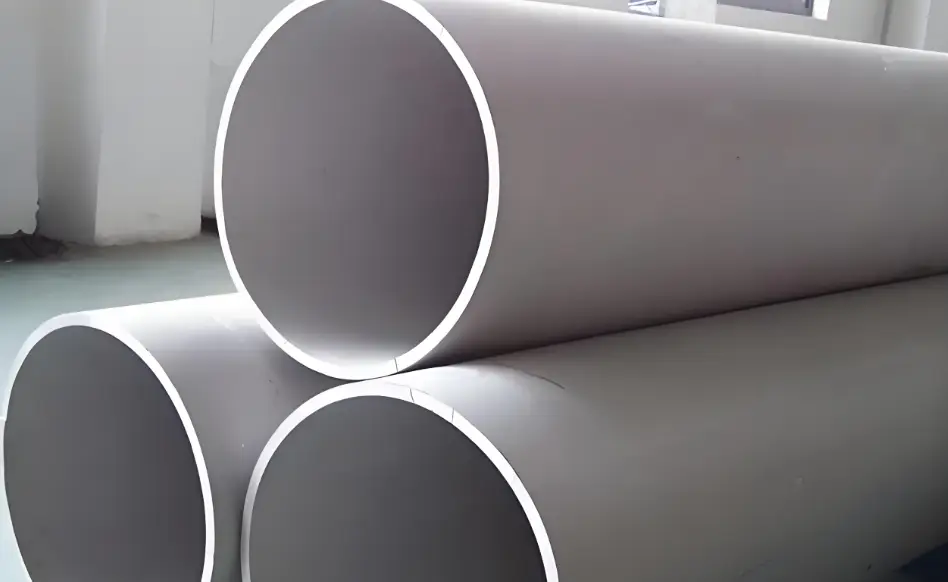
Inner Monologue: The Architecture of an Iron-Nickel-Chromium Superalloy
Engineering the Extreme: Incoloy 800H (UNS N08810) Seamless Solutions
Where Thermal Logic Meets Structural Integrity
In the relentless environment of high-temperature processing—where heat is both a tool and a destructive force—the choice of alloy is the only line of defense between operational success and catastrophic downtime. Our Incoloy 800H (UNS N08810) seamless pipes are not merely components; they are engineered safeguards for the modern petrochemical, power, and thermal processing industries.
The 800H Advantage: Why “Standard” Is Not Enough
While conventional stainless steels surrender their mechanical dignity above $550^\circ\text{C}$, our Incoloy 800H thrives in the “Creep Range.” By meticulously controlling the carbon chemistry ($0.05\% – 0.10\%$) and enforcing a high-temperature solution anneal, we deliver a pipe with a coarse grain morphology specifically designed to arrest grain boundary sliding.
-
Superior Creep-Rupture Strength: Engineered for 100,000+ hour lifecycles at temperatures reaching $800^\circ\text{C}$ and beyond.
-
Atmospheric Immunity: The high Nickel and Chromium matrix provides an impenetrable barrier against carburization, nitriding, and oxidation in fluctuating furnace environments.
-
Seamless Reliability: Our extrusion process eliminates the “weld-seam risk,” providing isotropic strength and uniform thermal expansion across the entire circumference of the tube.
Technical Performance Matrix
| Metric | Specification (UNS N08810) | Industrial Impact |
| Service Temp | Up to $1100^\circ\text{C}$ (Oxidation Limit) | Extended furnace component longevity. |
| Grain Size | ASTM No. 5 or Coarser | Maximized resistance to long-term deformation. |
| Nickel Content | $30.0\% – 35.0\%$ | Exceptional resistance to chloride stress corrosion. |
| Compliance | ASTM B407 / ASME SB407 | Guaranteed adherence to global safety codes. |
From the Billet to the Blast Furnace
We understand that in sectors like Steam Methane Reforming (SMR) and Ethylene Cracking, a single material failure can cost millions. That is why our production protocol exceeds standard mandates:
-
Vacuum Degassing: Ensuring ultra-low levels of deleterious trace elements.
-
Isothermal Testing: Validating creep performance through simulated service conditions.
-
Total Traceability: Every millimeter of pipe is mapped back to its original heat, provided with a comprehensive 3.1 Mill Test Certificate.
Technical Analysis: The High-Temperature Mastery of UNS N08810
1. The Chemistry of Stability
The performance of Incoloy 800H is a direct consequence of its controlled chemistry. The alloy is classified as a “super-austenitic” material, bridging the gap between conventional stainless steels and high-cost nickel-based superalloys.
The intentional control of Carbon is the pivot point. By keeping Carbon between $0.05 – 0.10\%$, the alloy ensures that enough carbides are present to provide high-temperature strength through precipitation hardening, yet not so much that the material loses its ductility or becomes impossible to weld.
Table I: Chemical Composition Limits (%)
| Element | UNS N08810 (Incoloy 800H) | Role in the Matrix |
| Nickel (Ni) | $30.0 – 35.0$ | Stabilizes Austenite; resists carburization/nitriding. |
| Chromium (Cr) | $19.0 – 23.0$ | Primary oxidation and corrosion resistance. |
| Iron (Fe) | $39.5 \text{ min.}$ | The base matrix, providing cost-effective bulk. |
| Carbon (C) | $0.05 – 0.10$ | Critical for high-temperature creep strength. |
| Al + Ti | $0.85 – 1.20$ | Combined for secondary phase strengthening. |
| Silicon (Si) | $\le 1.0$ | Improves oxidation resistance. |
| Manganese (Mn) | $\le 1.5$ | Assists in deoxidation and hot workability. |
2. The Solution Anneal and Grain Morphology
A critical differentiator for Incoloy 800H is the heat treatment. It must be solution annealed at a minimum of $1149^\circ\text{C}$ ($2100^\circ\text{F}$). This process serves two purposes: it dissolves any precipitated carbides back into the matrix and promotes grain growth.
In room-temperature applications, we want fine grains (Hall-Petch strengthening). However, at temperatures above $600^\circ\text{C}$, “grain boundary sliding” becomes the primary mechanism of failure. By forcing the grains to grow to an ASTM No. 5 or coarser, the total surface area of grain boundaries is reduced. This significantly lowers the rate of creep—the slow, permanent deformation under stress.
Table II: Mechanical Properties at Room Temperature
| Property | Minimum Value |
| Yield Strength (0.2% Offset) | $170$ MPa ($25$ ksi) |
| Ultimate Tensile Strength | $450$ MPa ($65$ ksi) |
| Elongation in 2 inches | $30\%$ |
| Hardness (Brinell) | $126 – 192$ HB |
3. Corrosion and Oxidation Resistance
While 800H is famous for its strength, its chemical resistance is equally vital. In the petrochemical industry, pipes are often exposed to “reducing” atmospheres. The high Nickel content prevents the alloy from absorbing Nitrogen (nitriding) or Carbon (carburizing) from the process gas. If a pipe becomes carburized, it turns brittle; a small thermal shock could then cause it to shatter like ceramic. Incoloy 800H remains ductile throughout its lifecycle.
Industrial Application: Where 800H Becomes Essential
The Petrochemical Heart
In ethylene production, the cracking furnaces operate at extreme temperatures. Incoloy 800H is the standard for pigtails, headers, and furnace tubing. It handles the transition from the radiant section to the convection section flawlessly.
Power Generation
In high-efficiency boilers and superheaters, 800H tubes are used because of their resistance to steam-side oxidation. Standard alloys would scale heavily, leading to reduced thermal efficiency and potential tube blockages.
Thermal Processing
For industrial heat-treating equipment—muffles, retorts, and baskets—800H provides the longevity required to make the equipment economically viable. It can survive thousands of heating and cooling cycles without significant warping or cracking.
Product Presentation: Our Incoloy 800H Seamless Solutions
We provide more than just dimensions; we provide thermal security. Our UNS N08810 seamless pipes are manufactured to the most stringent international standards (ASTM B407, ASME SB407), ensuring that your high-temperature operations remain uninterrupted.
Why Source Our 800H Pipes?
-
Precision Grain Control: Every batch is verified via metallographic examination to ensure an ASTM grain size of 5 or coarser, guaranteeing maximum creep-rupture life.
-
Surface Integrity: Our pipes undergo specialized pickling and passivation to ensure a clean, oxide-free surface, allowing for immediate protective $Cr_2O_3$ layer formation upon first heat.
-
Full Traceability: We provide comprehensive MTCs including high-temperature tensile test data upon request, ensuring your engineers have the exact data needed for finite element analysis (FEA).
Table III: Comparison of Creep-Rupture Strength ($100,000$ hours)
| Temperature | Incoloy 800 (Standard) | Incoloy 800H (UNS N08810) | Improvement |
| $700^\circ\text{C}$ | $45$ MPa | $68$ MPa | $+51\%$ |
| $800^\circ\text{C}$ | $18$ MPa | $32$ MPa | $+77\%$ |
The engineering choice for Incoloy 800H is a choice for the long term. While the initial capital expenditure is higher than stainless alternatives, the total cost of ownership is drastically lower due to reduced downtime and extended replacement cycles. In the relentless environment of high-temperature processing, 800H isn’t just a pipe; it’s the backbone of the plant.
You must be logged in to post a comment.