
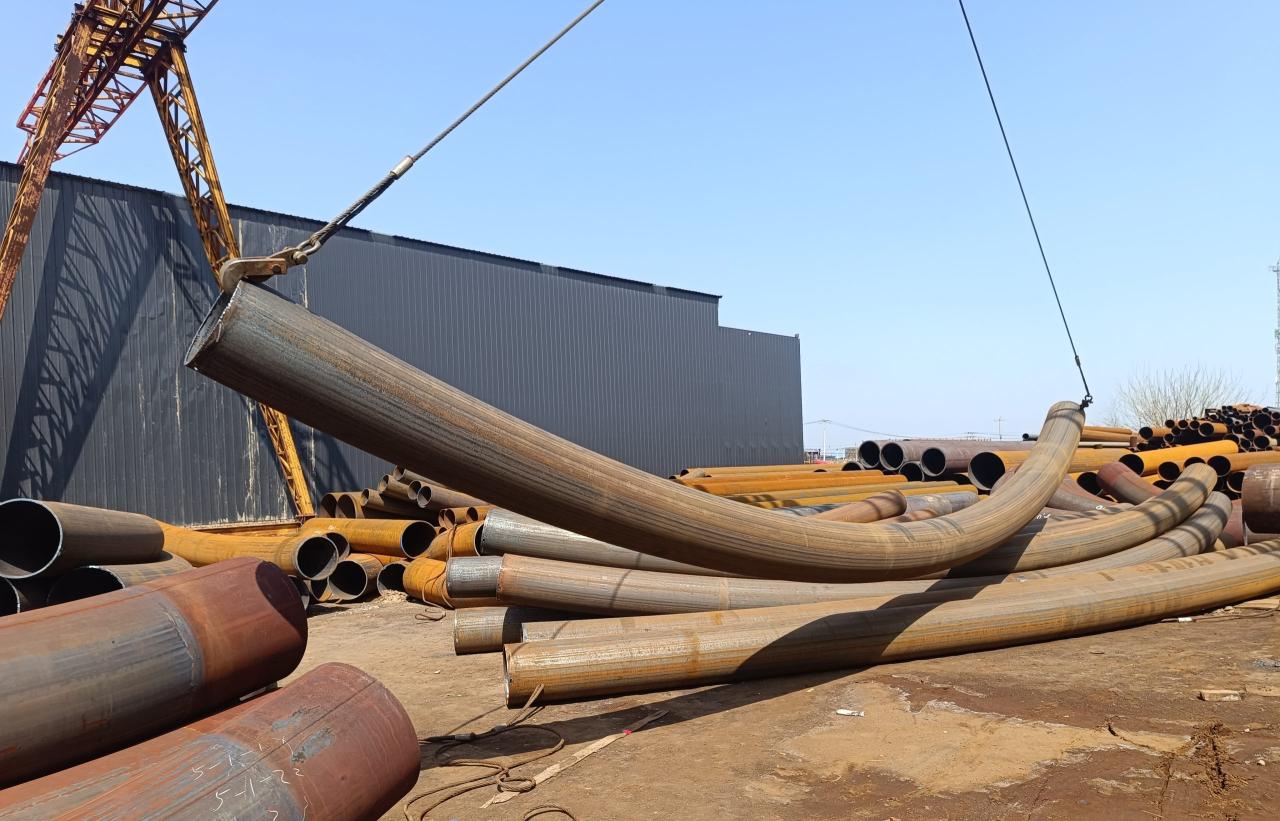
When we discuss the “bend” in a pipeline, we are discussing the very flex and flow of global industry; it is the silent, curved backbone of the energy that powers our cities and the water that sustains our lives. Our company does not simply manufacture “fittings”; we engineer geometric solutions that redefine the limits of fluid transportation. In a world where efficiency is measured in micro-joules and project lifespans are calculated in decades, the quality of your pipe bends—from the compact 2D to the sweeping 8D—is the ultimate differentiator between a system that survives and a system that thrives.
Why choose our bends? Because we understand that a 10-inch pipeline using a 30-inch radius (3D) faces fundamentally different hydraulic stresses than one using a 50-inch radius (5D). Our 5D bends offer a “Smooth Performance” profile that changes direction with the grace of a natural river, reducing the “Dean Vortices” that cause internal friction and localized wear. This is particularly crucial for large-diameter pipelines in the oil and gas sector, where the sheer volume of material being moved means that even a 1% reduction in flow resistance can save millions of dollars in energy costs over the life of the asset. Our ability to produce bends up to 60 inches in diameter (DN1500) ensures that we can support the most ambitious “Mega-Projects” on the planet, from deep-sea gas gathering systems to trans-continental oil networks.
Our material versatility is unmatched. Whether your project demands the rugged reliability of ASTM A234 WPB for standard utility lines, the high-pressure tolerance of WPHY 70 for specialized pipeline infrastructure, or the high-temperature resilience of WP91 for power plant headers, our technical team ensures that the bending process honors the specific metallurgy of the alloy. We don’t just bend pipe; we preserve its soul. Every bend leaves our facility with a documented pedigree of heat treatment and tensile verification, ensuring that when you weld our 90-degree or 45-degree fittings into your system, they become a seamless, uncompromising extension of your vision.
The harshness of the environment is where our coatings truly shine. From the “Galvanized” finish that resists the salt spray of offshore platforms to the “3PE” and “FBE” coatings that act as an impenetrable armor against the corrosive soils of the desert, we provide a multi-layered defense system. Our bends are designed to be the “strongest link” in your chain. When you choose our 2D, 2.5D, 3D, 5D, 6D, or 8D bends, you are choosing a partner that looks beyond the blueprint to the reality of the field—the reality of pressure spikes, thermal shocks, and the relentless flow of time. We provide the curve that keeps the world moving forward.
When we step into the intricate world of fluid dynamics and the structural geometry of piping systems, we are immediately confronted with the profound reality that a “bend” is far more than a simple change in direction; it is a critical intersection of metallurgical integrity, thermodynamic efficiency, and mechanical resilience where the forces of pressure, temperature, and erosion converge with surgical intensity. The philosophy behind our Pipe Bend Fittings—spanning the spectrum of 2D, 2.5D, 3D, 5D, 6D, and 8D radii—is rooted in the understanding that the curvature of a pipe dictates the energy loss of the system through turbulence and boundary layer separation, and consequently, the long-term fatigue life of the entire infrastructure. When a designer specifies a 5D or 8D bend over a standard short-radius elbow, they are effectively choosing to minimize the centrifugal forces exerted on the outer wall (the extrados) and reduce the pressure drop across the fitting, which is paramount in high-velocity oil and gas pipelines or high-viscosity slurry transportation where every psi of pressure lost translates directly into increased pumping costs and accelerated wall thinning. Our manufacturing ethos treats the bending process as a transformative event where a straight, seamless, or welded pipe—be it Carbon Steel API 5L Grade B, high-yield X70, or sophisticated Stainless Steel 316L—is subjected to induction heating or cold forming to achieve a precise radius, a process that demands a holistic view of the material’s grain structure and its reaction to thermal gradients to ensure that the final product maintains the design wall thickness and avoids the deleterious effects of ovality or excessive wrinkling on the intrados.
The Metallurgical Soul of Pipe Bends: Material Composition and Synergy
The choice of material for a pipe bend is the foundational decision that determines its fate in the field, as the chemical composition must not only withstand the internal process fluid but also survive the intense deformation of the bending process itself. For high-yield materials like API 5L X65 or X70, the carbon equivalent (CE) must be meticulously managed to ensure that the heat-affected zone of the bend remains ductile and weldable, while for alloy steels such as ASTM A234 WP91, the presence of chromium, molybdenum, and vanadium creates a complex microstructure that resists creep and hydrogen-induced cracking at elevated temperatures. In the world of stainless steel bends, such as WP304L or WP316L, the low carbon content is the primary defense against sensitization and intergranular corrosion, ensuring that the bending process does not trigger the precipitation of carbides at the grain boundaries which would otherwise create a path for rapid failure in acidic or saline environments. The following table illustrates the typical chemical boundaries we adhere to for our most requested carbon and alloy steel grades, ensuring that the “raw” material provides a robust baseline for the mechanical transformations to come.
| Grade | Carbon (C) max | Manganese (Mn) | Silicon (Si) | Chromium (Cr) | Molybdenum (Mo) | Phosphorus (P) max | Sulfur (S) max |
| ASTM A234 WPB | 0.30% | 0.29 – 1.06% | 0.10% min | 0.40% | 0.15% | 0.050% | 0.058% |
| API 5L X65 (PSL2) | 0.12% | 1.30 – 1.45% | 0.45% | 0.30% | 0.15% | 0.020% | 0.010% |
| ASTM A234 WP11 | 0.05 – 0.15% | 0.30 – 0.60% | 0.50 – 1.00% | 1.00 – 1.50% | 0.44 – 0.65% | 0.030% | 0.030% |
| ASTM A234 WP91 | 0.08 – 0.12% | 0.30 – 0.60% | 0.20 – 0.50% | 8.00 – 9.50% | 0.85 – 1.05% | 0.020% | 0.010% |
Thermal Evolution: The Necessity of Heat Treatment
A pipe bend is born through a struggle of forces, and the resulting internal stresses can be catastrophic if not resolved through scientifically rigorous heat treatment protocols. Whether we are discussing 3D bends for urban water systems or 8D bends for cross-country gas lines, the bending process—especially induction bending—creates a thermal gradient where the material is heated to an austenitic state ($850^{\circ}C$ to $1050^{\circ}C$) and then rapidly quenched or air-cooled. This creates a non-homogeneous microstructure that must be normalized or tempered to restore the equilibrium of the lattice. For high-yield pipeline steels, we often employ a “Stress Relief” or “Normalize and Temper” cycle to ensure that the yield strength is uniform across the extrados and the straight tangent ends. In the case of alloy steels like WP22 or WP91, the heat treatment is even more critical; it is a surgical procedure that manages the transformation from austenite to tempered martensite, providing the necessary hardness without sacrificing impact toughness at sub-zero temperatures.
| Material Category | Heat Treatment Type | Temperature Range | Cooling Method |
| Carbon Steel (WPB/WPC) | Normalizing | $870^{\circ}C – 980^{\circ}C$ | Still Air |
| High Yield (X60/X70) | Stress Relieving | $540^{\circ}C – 650^{\circ}C$ | Controlled Cooling |
| Alloy Steel (WP11/WP22) | Full Annealing | $850^{\circ}C – 950^{\circ}C$ | Furnace Cool |
| Stainless Steel (304L/316L) | Solution Annealing | $1040^{\circ}C – 1150^{\circ}C$ | Rapid Water Quench |
Mechanical Resilience: Tensile Requirements and Flow Dynamics
The mechanical integrity of a bend is measured by its ability to contain pressure while resisting the external loads of thermal expansion and ground movement. In large-diameter bends (up to 60 inches), the “Wall Thinning” on the outer radius is a critical engineering constraint; as the pipe is stretched to form the curve, the wall thickness reduces, necessitating an initial starting pipe that is thicker than the nominal schedule to ensure the final bend meets the minimum requirements of ASME B16.49 or API 5L. Our tensile testing protocols verify that the yield and ultimate strengths remain within the specified range, even after the cold-work or thermal cycling of the bending process. This is particularly vital for 6D and 8D bends, which are often used in “Pigging” operations where the internal surface must be smooth enough for inspection tools to pass without snagging, requiring perfect internal alignment and consistent tensile properties to prevent localized deformation under the pressure of the pig.
| Grade | Yield Strength (min) | Tensile Strength (min) | Elongation (min) |
| ASTM A234 WPB | 240 MPa (35 ksi) | 415 MPa (60 ksi) | 22% |
| API 5L X70 | 485 MPa (70 ksi) | 570 MPa (82.7 ksi) | 18% |
| ASTM A403 WP316L | 170 MPa (25 ksi) | 485 MPa (70 ksi) | 28% |
| ASTM A234 WP91 | 415 MPa (60 ksi) | 585 MPa (85 ksi) | 20% |
Working Conditions: Erosion, Corrosion, and the Coating Shield
In the field, a pipe bend is the most harassed component in the system. As fluid rounds the corner, the “Centrifugal Pressure” forces heavier particles or corrosive ions against the outer wall, making the extrados a prime target for erosion-corrosion. To mitigate this, we offer an array of protective coatings. For buried pipelines, 3PE (Three-Layer Polyethylene) or FBE (Fusion Bonded Epoxy) provides a dielectric barrier that prevents soil-born oxygen and moisture from reaching the steel surface. For high-temperature steam lines, galvanized or heat-resistant black paints are used to prevent atmospheric oxidation. The geometric choice of radius (e.g., opting for an 8D bend instead of a 3D) is itself a form of “corrosion control,” as the gentler curve reduces the impingement angle of particles, significantly extending the service life of the fitting in abrasive environments like mining or sand-heavy oil extraction.
You must be logged in to post a comment.